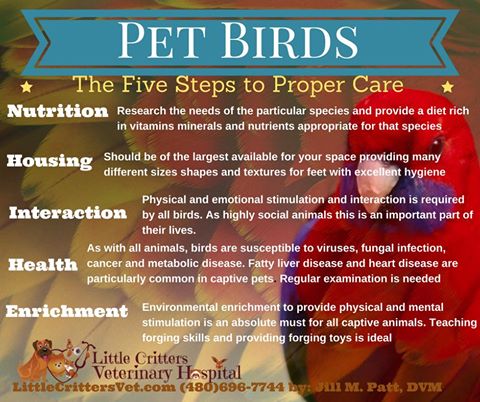
|
Pet Bird Care - The Basics:
Diet
In general, you need to provide a large variety of fresh food for your bird. However it is important to know the needs of your particular bird because all species have unique dietary and environment needs. Please do your research.
For many of our companion parrots, a core diet of an organic, color free avian pellets, appropriate for the species, and a large variety of vegetables should be offered daily.
Chop is also a popular addition and can be created with a mixture of chopped vegetables and cooked whole grains.
Seeds should be limited to training treats except for the small birds such as finches, budgies and cockatiels which should have a 50% seed diet.
Clean sprouted seeds can also be offered and are a good way of introducing greens to the stubborn eater. See SproutPeople.org for good sprouting information.
Fruits should be limited as a treat only with the exception of certain species such as Lories.
Offer clean, fresh water at all times.
Many species have additional nutritional needs – please research your particular bird’s needs or give us a call if you have any questions.
Supplements
Generally are not needed for those birds on a good balanced diet and some supplements can create toxicity if overdone.
UNIQUE SPECIES NEEDS:
Bird species have adapted to many different environmental conditions which has structured their dietary needs. It is impossible to cover all of them in this booklets, so please do your research, but a few individual needs are listed below.
Fats: Nuts
Macaws tend to need a higher content of fat in their diets which should be offered from nuts. It is important to not over do this as obesity is common in pet birds. All birds benefit from omega 3 fatty acids and can be obtained from formulated diet ad nuts such as walnuts.
Calcium:
Breeding birds, immature birds and African Gray's tend to need a higher calcium content. All birds require dietary calcium. Calcium is obtained from formulated diet (pellets), vegetables, and supplementation such as cuttle bone and Tums.
Vitamin A:
Eclectus parrots are known to need high vitamin A diets but care should be taken to not over supplement which could lean to toxicity. An eclectus specific diet is recommended. Vitamin A is available in green and orange vegetables.
Vitamin D:
Available from exposure to sunlight, vitamin D fortified diets, and vegetables.
Toxicity: Is common with fat soluble vitamins and care should be taken to proved a balanced diet.
Nectar: Nectar is part of the wild diet of birds such as lories and lorikeets which have specialized tongues to utilize this food source. Formulated diets are available for these birds and should be provided. A seed diet is not appropriate for lories.
Medical Concerns
Numerous!
Feather picking, skin mutilation, respiratory disease, eye infections, trauma, organ disease, malnutrition, reproductive problems and many more. Basically what can go wrong just might. Call your veterinarian if you notice any of the signs of a sick bird.
Sick Bird Care
As soon as illness is detected in your pet, please bring your pet to your veterinarian for a thorough physical examination. A diagnostic work-up may need needed and could blood analysis, fecal examination, radiographs, skin scraping, cultures, and others.
Diagnostics are very important in allowing your veterinarian to take a "peak inside" your bird in order to identify the cause of your birds symptoms and formulate an appropriate and specific therapeutic course to allow full recovery.
Once the cause of the symptoms as been identified a therapeutic recommendation will be made which may include: dietary changes, medication, and environmental changes.
It is important to follow these recommendation closely and provide all recommend care to allow for a full recovery. If problems arise with recommended changes or medication administration please contact your veterinarian.
Learn to recognize a sick bird. It is common for the first signs to go unnoticed. The first signs usually include:
- Changes in behavior, such as decreased activity level or decreased vocalization
- Decreased appetite - Remember that birds will pretend that they are eating, so don't be fooled
- Diarrhea or persistent abnormal droppings
- Too much fluid in the droppings (polyuria)
- Fluffed feathers or changes in the feathers
- Changes in general appearance and posture
- Sitting on the cage bottom
- Coughing, sneezing, abnormal breathing sounds
- Nasal discharge
- Frequent scratching at the nares or the side of the head
- Tail bobbing
- Weight loss
- Regurgitating, vomiting
- Change in water intake
- Weakness
Medical Progress Exams:
Your veterinarian will suggest rechecking the patient at variable intervals depending on the state of debilitation or changes in care required.
The medical progress exam allows us to assess your bird’s response to treatment and your compliance and understanding with instructions and recommendations.
Many times in the course of treating an exotic pet the treatment must be altered somewhat to ensure the best response.
These rechecks are also used as a way of reinforcing the changes needed for the bird to remain healthy.
Lab values may be rechecked to ensure that your bird is truly recovering and not just feeling well enough again to resume hiding any weakness.
The goal is complete recovery of your pet to prevent relapse or chronic disease states.
Serious signs of Illness
Please call us immediately if your bird is exhibiting any of these symptoms:
- Drooping wing or wings
- Falling off the perch
- Eyes closed with long periods of sleepiness
- Vomiting/regurgitation
- Frequent sneezing with or without discharge
- Discharge from nostrils, eyes, mouth or any part of the body
Environmental Enrichment:
Environmental enrichment basically means to provide adequate mental and physical stimulation i the home environment in order for your bird to be mentally and physically healthy.
Many examples of enrichment are available if we look at zoo design. In the past they were kept in small cages with the only thought being the viewable audience. Now modern zoos are structured so that the environment provide mental stimulation and prevents abnormal repetitive behaviors in animals such as pacing.
Cage:
Bigger is better! Get the largest cage you can for your bird. Cages should have many perches of varying textures, shapes and sizes. The bar sizes should prevent a head from getting through and possible stuck. A good size cage will allow substantial "real estate" for your bird to do various activities. Consider offering an outdoor aviary that is bird safe and protected from wild birds and their droppings. This can be used during good weather to provide additional stimulation and exercise.
Food & Water:
Should always be available but we we recommend using smaller food dishes and placing them all over the cage to encourage movement throughout the day. We also recommend keeping high value foods (nuts & seeds) for training and foraging toys.
Toys:
Enrichment toys are vitally important for your bird an not optional.
Toys provide excellent foraging opportunities for your birds which will provide both mental and physical stimulation. Toys should be bird safe so that heads and toes cannot get stuck and should be produced with of non-toxic chemicals.
Foraging:
What is it and why is it important? Our companion birds have adapted from a wild environment in which they would be interacting with dozens of other flock members, expanding physical energy by flying to food sources throughout the day, and using their minds to search for food in various environments. We take these same birds and place them alone in a small cage with a full bowl of food and water and ask they to be happy.
Does this seem reasonable? So how to we provide for happiness? The answer is often with appropriate environment and this includes foraging toys. The definition of foraging according to Merriam-Webster is to wander in search of forage of food or to search. So how do we do this in a cage environment? With toys! Foraging toys are those toys constructed in such a way as to require the bird to look through and manipulate the toy in such a way as to get a highly valued food treat. It is important when filling these that a small treat is offered for a large effort in order to keep they body and brain occupied.
Some examples of easy home made items include:
Toilet paper or paper towel rooms (empty) with a small treat inside and the ends rolled shut, small paper cups with a seed placed inside and waded into a ball, paper taped over the food bowls with higher value treats,& seeds placed in a phone book.\\
For more information on foraging see these resources:
Lafeber
Good Bird Inc
Captive Foraging DVD - Highly Recommended Parrot
Enrichment - toys
Associal of Avian Veterinarians
Training:
Did you know you can train your bird? Bird training is actually pretty easy and very rewarding for your and the bird. It not only provides necessary mental stimulation for the bird but will often solve or prevent problems.
Some simple things to train are potty on command when on out cage, recall, and step-up.
Additional useful things to train include lay on back and allow nail filing, raising wings on cue, opening mouth, lifting a foot, lowering head and many others.
Training can be done with a clicker just as you'd train your dogs and should include high value rewards such as nuts and seeds in tiny amounts. See these resources for more on bird training.
Good Bird Inc
Bird Tricks
Lafeber
|



 Processing ....